86,400
=1,440 minutes
=24 hours
=1 day
Use this page for quick answers, custom conversions, copyable results, and the next most common time calculations people ask after this one.
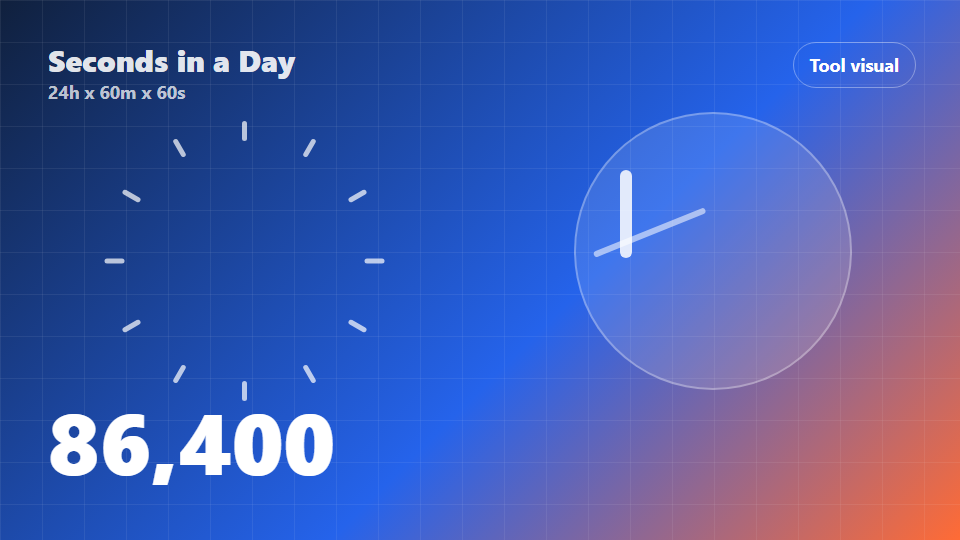
A standard day has 86,400 seconds. Convert any time value below and keep moving into the next useful tool.
Use this page for quick answers, custom conversions, copyable results, and the next most common time calculations people ask after this one.
Start with a common example or enter your own number.
Enter a value to convert it into seconds, minutes, hours, days, and weeks.
 Seconds in a year
Scale this answer up to a standard year and keep the same answer-first layout.
Open tool
Seconds in a year
Scale this answer up to a standard year and keep the same answer-first layout.
Open tool
 Minutes in a week
Good next step for schedules, routines, and weekly planning calculations.
Open tool
Minutes in a week
Good next step for schedules, routines, and weekly planning calculations.
Open tool
 Hours in a month
Useful for billing, staffing, and monthly planning estimates.
Open tool
Hours in a month
Useful for billing, staffing, and monthly planning estimates.
Open tool
Three natural next steps after the initial answer.
Use the calculator above for any number of seconds, minutes, hours, days, weeks, or years.
Jump back to calculatorMove straight into yearly, weekly, and monthly answer pages without losing context.
Browse time toolsCopy a full result string or generate a shareable query URL after any conversion.
See result actions| Days | Seconds | Minutes | Hours |
|---|---|---|---|
| 0.25 day | 21,600 seconds | 360 minutes | 6 hours |
| 0.5 day | 43,200 seconds | 720 minutes | 12 hours |
| 1 day | 86,400 seconds | 1,440 minutes | 24 hours |
| 2 days | 172,800 seconds | 2,880 minutes | 48 hours |
| 7 days | 604,800 seconds | 10,080 minutes | 168 hours |
| 30 days | 2,592,000 seconds | 43,200 minutes | 720 hours |
| 365 days | 31,536,000 seconds | 525,600 minutes | 8,760 hours |
Use SECONDS_PER_DAY = 86400 for standard duration math, TTL values, cache expiry, and simple Unix time calculations.
For calendar logic, time zones, and daylight saving transitions, use a date-time library instead of adding fixed seconds to local dates.
A local calendar day can appear to have 23 or 25 hours during DST changes, but standard unit conversion uses 86,400 seconds.
UTC can include leap seconds. For everyday time conversion, 1 day is still treated as 86,400 seconds.
Months vary from 28 to 31 days. A standard non-leap year has 365 days, or 31,536,000 seconds.
There are 86,400 seconds in a standard 24-hour day.
Multiply 24 hours by 60 minutes by 60 seconds: 24 x 60 x 60 = 86,400.
There are 1,440 minutes in a day.
For standard time conversion, yes. Astronomical days and local daylight saving calendar days can vary.
Half a day is 43,200 seconds.
A 7-day week has 604,800 seconds.
It is the standard number of seconds in a 24-hour day for timers, TTLs, and duration math.
Formula: 1 day = 24 hours x 60 minutes x 60 seconds = 86,400 seconds.